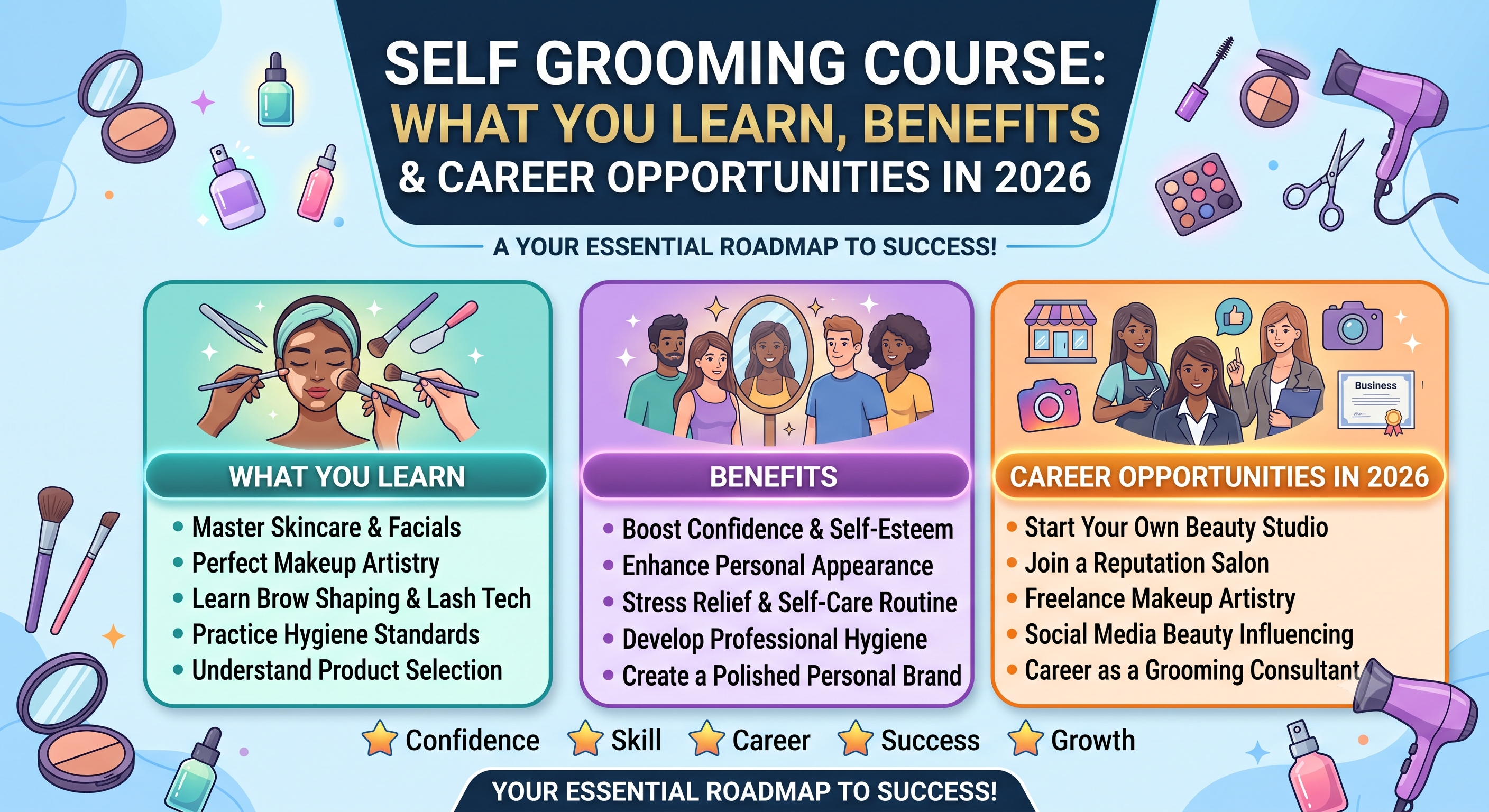
Self Grooming Course: What You Learn, Benefits & Career Opportunities in 2026
Self Grooming Course: What You Learn, Benefits & Career Opportunities in 2026
A well-groomed appearance can improve confidence, communication, and the way we present ourselves in personal and professional situations. In 2026, self grooming is no longer limited to occasional salon visits. People increasingly want to understand how to maintain their hair, skin, makeup, nails, and overall appearance independently.
A Self Grooming Course provides practical knowledge that helps beginners develop everyday beauty and grooming skills. Instead of depending entirely on a professional for routine grooming, we learn how to create simple, polished looks ourselves.
From skincare and hair care to basic makeup, nail care, personal hygiene, and styling, a well-designed self grooming course can teach useful skills for students, working professionals, homemakers, entrepreneurs, and anyone interested in improving their personal presentation.
What Is a Self Grooming Course?
A self grooming course is a practical beauty training program designed to teach individuals how to look after their personal appearance and perform basic grooming services on themselves.
Unlike a professional beautician course, which focuses on providing beauty services to clients, self grooming training focuses primarily on personal use.
Depending on the academy and curriculum, a course may cover:
- Basic skincare
- Daily skincare routine
- Facial care
- Hair care
- Hair styling
- Basic makeup
- Eye makeup
- Hairstyling
- Nail care
- Manicure and pedicure basics
- Eyebrow grooming
- Personal hygiene
- Product knowledge
- Beauty tools
- Outfit coordination
- Personal presentation
The exact syllabus varies by training institute, so we should always check the curriculum before enrolling.
Why Learn Self Grooming in 2026?
Modern lifestyles are fast-paced, and people increasingly want practical beauty routines that fit into their daily schedules.
Learning self grooming can help us become more confident in managing our appearance for different occasions, including:
- College
- Job interviews
- Office meetings
- Business events
- Parties
- Weddings
- Festivals
- Photoshoots
- Social gatherings
- Everyday life
The biggest advantage is that we learn how to make informed grooming choices rather than simply copying beauty trends.
What Do We Learn in a Self Grooming Course?
1. Basic Skincare
Skincare is usually one of the foundations of self grooming.
We learn how to understand our basic skin type and create a suitable routine involving:
- Cleansing
- Moisturizing
- Exfoliation
- Basic facial care
- Skin preparation
- Sun protection
- Product application
A good course should also explain that skincare is not identical for everyone. Dry, oily, combination, and sensitive skin may require different approaches.
2. Understanding Your Skin Type
Learning our skin type helps us choose appropriate cosmetic and skincare products.
A self grooming course may teach us how to recognize characteristics associated with:
- Normal skin
- Dry skin
- Oily skin
- Combination skin
- Sensitive skin
The objective is to build a simple routine that suits individual needs rather than using every product that becomes popular online.
3. Basic Facial Techniques
Some self grooming courses introduce simple facial-care techniques that can be performed safely at home.
These may include:
- Cleansing
- Gentle exfoliation
- Face massage
- Face mask application
- Moisturizer application
We should always follow product instructions and avoid aggressive techniques that may irritate the skin.
4. Hair Care Basics
Hair is a major part of personal grooming. A self grooming course can teach us how to develop better everyday hair-care habits.
Topics may include:
- Hair washing
- Conditioner application
- Hair brushing
- Basic hair maintenance
- Heat protection
- Hair styling products
- Hair-care routines
We can also learn how different hair textures may require different care approaches.
5. Easy Hairstyles for Everyday Use
One of the most practical parts of self grooming training is learning hairstyles that we can create independently.
Depending on the course, we may learn:
- Straight hair styling
- Basic curls
- Waves
- Ponytails
- Braids
- Buns
- Simple party hairstyles
- Office hairstyles
- Quick everyday styles
These skills can be especially useful when we have limited time before work, college, or an event.
6. Basic Makeup Skills
Makeup is another important part of self grooming.
Beginners can learn how to create a natural and polished look rather than relying on complicated techniques.
Basic training may include:
- Skin preparation
- Primer
- Foundation
- Concealer
- Compact or setting products
- Blush
- Highlighter
- Eyebrow grooming
- Eyeliner
- Mascara
- Lip colour
The goal is to understand how much makeup is appropriate for different occasions and how to apply it neatly.
7. Eye Makeup
Eye makeup can completely change the appearance of a look.
A self grooming course may introduce:
- Basic eyeshadow
- Eyeliner
- Kajal
- Mascara
- Simple eye blending
- Eyebrow definition
- False eyelashes
Beginners should first master simple techniques before progressing toward more advanced eye looks.
8. Nail Care
Well-maintained nails are an important part of personal grooming.
Basic nail-care training may include:
- Nail shaping
- Cuticle care
- Nail cleaning
- Nail polish application
- Basic French manicure
- Simple nail art
- Hand care
The emphasis should be on cleanliness and proper care rather than complicated designs.
9. Eyebrow and Facial Grooming
Eyebrows strongly influence facial appearance. Self grooming programs may explain how to maintain eyebrow shape and facial grooming.
Depending on the curriculum, students may learn about:
- Eyebrow shaping
- Threading basics
- Facial hair grooming
- Upper-lip grooming
- Basic waxing precautions
When performing any grooming technique at home, we should follow safe procedures and be especially careful with sensitive skin.
10. Personal Hygiene and Presentation
Self grooming is not only about makeup and hairstyles.
Professional grooming also includes:
- Personal cleanliness
- Hair cleanliness
- Oral hygiene
- Nail hygiene
- Fresh clothing
- Appropriate fragrance
- Clean footwear
- Neat appearance
A polished appearance is created by combining several small habits consistently.
11. Product Knowledge
A good self grooming course should teach us how to understand beauty products rather than encouraging unnecessary purchases.
We can learn:
- What different products are designed for
- How to read basic ingredient information
- How to select products according to our needs
- How much product to use
- How to store products
- When products should be replaced
- How to follow manufacturer instructions
This knowledge can help us avoid buying products simply because they are trending.
12. Beauty Tools and Their Correct Use
Self grooming often involves tools such as:
- Hair brushes
- Combs
- Hair dryers
- Straighteners
- Curling tools
- Makeup brushes
- Sponges
- Eyelash tools
- Nail tools
A professional course should explain appropriate use, cleaning, storage, and basic safety precautions.
Benefits of a Self Grooming Course
1. Builds Confidence
Knowing how to manage our own appearance can increase confidence.
When we understand how to style our hair, apply basic makeup, maintain our skin, and dress appropriately, we can feel more prepared for different situations.
2. Saves Time
Once we learn efficient grooming routines, we can perform many everyday tasks ourselves.
Instead of spending significant time preparing for every occasion, we can develop quick routines suited to our schedule.
3. Can Reduce Routine Beauty Expenses
Learning basic grooming skills can reduce our dependence on salons for simple everyday services.
However, professional salon services may still be preferable for specialized or technically demanding treatments.
4. Improves Personal Presentation
Good grooming can contribute to a polished appearance at work, college, meetings, interviews, and social events.
5. Helps Us Choose Products More Wisely
Product knowledge can prevent unnecessary purchases and help us build a more practical beauty routine.
6. Useful for Special Occasions
Self grooming skills can be especially useful before:
- Weddings
- Festivals
- Parties
- Vacations
- Photoshoots
- Professional events
- Celebrations
We can create simple hairstyles and makeup looks without always needing outside assistance.
Who Should Join a Self Grooming Course?
A self grooming course can be useful for a wide range of learners.
Students
Students can learn simple grooming and presentation skills for college, interviews, internships, and social events.
Working Professionals
Professionals can learn quick office-appropriate makeup, hairstyles, skincare routines, and overall grooming.
Homemakers
Self grooming training can provide practical knowledge for maintaining personal appearance at home.
Beginners in Beauty
Those considering a career in beauty can use self grooming training as an introduction before progressing to professional beautician or makeup courses.
Content Creators
People creating beauty, fashion, or lifestyle content can benefit from better understanding of makeup, hair styling, and presentation.
Self Grooming Course vs Professional Beautician Course
These two courses have different objectives.
| Self Grooming Course | Professional Beautician Course |
|---|---|
| Focuses on personal grooming | Focuses on professional client services |
| Primarily for self-use | Designed for salon careers |
| Teaches basic beauty techniques | Covers broader technical procedures |
| Suitable for beginners | Suitable for aspiring beauty professionals |
| Emphasizes everyday routines | Includes client consultation and service procedures |
| Usually shorter and more focused | Often more comprehensive |
If our primary goal is to improve our personal appearance, a self grooming course may be suitable.
If we want to work as a beautician or start a salon, a professional beauty course is generally more appropriate.
How to Choose the Best Self Grooming Course
Before joining a course, we should evaluate several factors.
Check the Curriculum
Make sure the course covers the skills we actually want to learn, such as skincare, makeup, hair styling, nail care, and personal presentation.
Look for Practical Training
Self grooming is a hands-on subject. Demonstrations are useful, but we should also have opportunities to practise techniques ourselves.
Consider Trainer Experience
Experienced trainers can provide better guidance on technique, product selection, tools, hygiene, and common mistakes.
Check Course Duration
The ideal duration depends on the curriculum. A very short course may provide an introduction, while a more comprehensive program may require additional practice.
Ask About Products and Tools
Find out whether students practise with professional products and whether they are taught how to use and maintain beauty tools properly.
Career Opportunities After a Self Grooming Course
A self grooming course is primarily designed for personal development rather than direct professional employment. However, it can serve as a useful foundation for further beauty education.
After completing self grooming training, interested learners can progress to:
- Professional Beautician Course
- Makeup Artist Course
- Bridal Makeup Course
- Hair Styling Course
- Hair Cutting Course
- Skin Care Course
- Nail Art Course
- Salon Management Course
With advanced professional training, learners can explore careers such as beautician, makeup artist, hairstylist, nail artist, skincare professional, beauty trainer, freelancer, or salon entrepreneur.
How to Build a Daily Self Grooming Routine
A simple routine can be more effective than an unnecessarily complicated one.
Morning
- Cleanse appropriately
- Moisturize
- Apply suitable sun protection
- Style hair
- Perform basic grooming
- Apply simple makeup if desired
During the Day
- Maintain personal hygiene
- Keep hair neat
- Reapply sun protection when appropriate
- Avoid unnecessary touching of the face
Evening
- Remove makeup thoroughly
- Cleanse the skin
- Follow an appropriate skincare routine
- Brush and maintain hair
- Keep beauty tools clean
Consistency is more important than using a large number of products.
Common Self Grooming Mistakes to Avoid
Beginners often make mistakes when following beauty trends without understanding their individual requirements.
Common mistakes include:
- Using too many skincare products
- Over-exfoliating
- Sleeping with makeup on
- Sharing personal makeup products
- Using dirty makeup brushes
- Applying excessive heat to hair
- Ignoring heat protection
- Using expired cosmetics
- Copying every online beauty trend
- Choosing products without considering skin or hair needs
Professional self grooming is about informed choices, not simply following trends.
Frequently Asked Questions About Self Grooming Courses
What is taught in a self grooming course?
A self grooming course may teach skincare, basic facial care, hair care, hairstyling, makeup, nail care, eyebrow grooming, personal hygiene, product knowledge, and overall presentation.
Is a self grooming course useful for beginners?
Yes. It is particularly useful for beginners who want to understand basic beauty and grooming techniques and become more confident in managing their own appearance.
Can a self grooming course help with makeup?
Yes. Many programs include basic makeup techniques such as foundation application, concealing, eye makeup, blush, highlighting, lip makeup, and creating simple looks for different occasions.
Can we get a job after a self grooming course?
A self grooming course is generally designed for personal development rather than direct professional employment. Those seeking a beauty career should consider progressing to a professional beautician, makeup, hair, skincare, or other specialized course.
How long is a self grooming course?
Course duration varies depending on the academy and syllabus. Short workshops may cover essential techniques, while comprehensive courses may provide more extensive practical training.
Is self grooming the same as a beautician course?
No. Self grooming focuses primarily on maintaining and styling our own appearance. A professional beautician course is designed to teach us how to provide beauty services to clients.
Conclusion
A Self Grooming Course in 2026 can provide practical skills for anyone who wants to improve their skincare, hair care, makeup, nail care, hygiene, and overall personal presentation.
The biggest benefit is not simply learning how to look better—it is developing the knowledge and confidence to manage our own grooming routine effectively.
For beginners, students, working professionals, homemakers, and beauty enthusiasts, self grooming can be a valuable introduction to the wider beauty industry. Those who discover a deeper interest in beauty can continue their education through professional beautician, makeup, hair, skincare, nail, or salon management courses.
With consistent practice, the right products, proper hygiene, and a personalized approach, self grooming can become a practical and enjoyable part of everyday life.