HydraFacial Course in India: Training, Skills, Career Scope & Certification Guide
HydraFacial Course in India: Training, Skills, Career Scope & Certification Guide
The demand for professional skincare treatments is growing rapidly in India as clients become more interested in healthy-looking, hydrated, smooth, and refreshed skin. Among the treatments commonly offered in professional beauty and aesthetic settings, HydraFacial-style treatments have gained significant attention for their multi-step approach to cleansing, exfoliation, extraction, and hydration.
For beauty professionals, learning advanced facial techniques can create opportunities to expand their service portfolio and work in salons, skincare studios, spas, beauty clinics, and aesthetic environments. A HydraFacial course in India can introduce learners to the principles, equipment, product selection, hygiene practices, consultation, and practical procedures involved in these treatments.
However, professional training should also make clear the difference between cosmetic salon services and medical aesthetic procedures. The exact treatment protocol, equipment, products, and permitted scope of practice can vary, so students should choose training appropriate to their qualifications and local requirements.
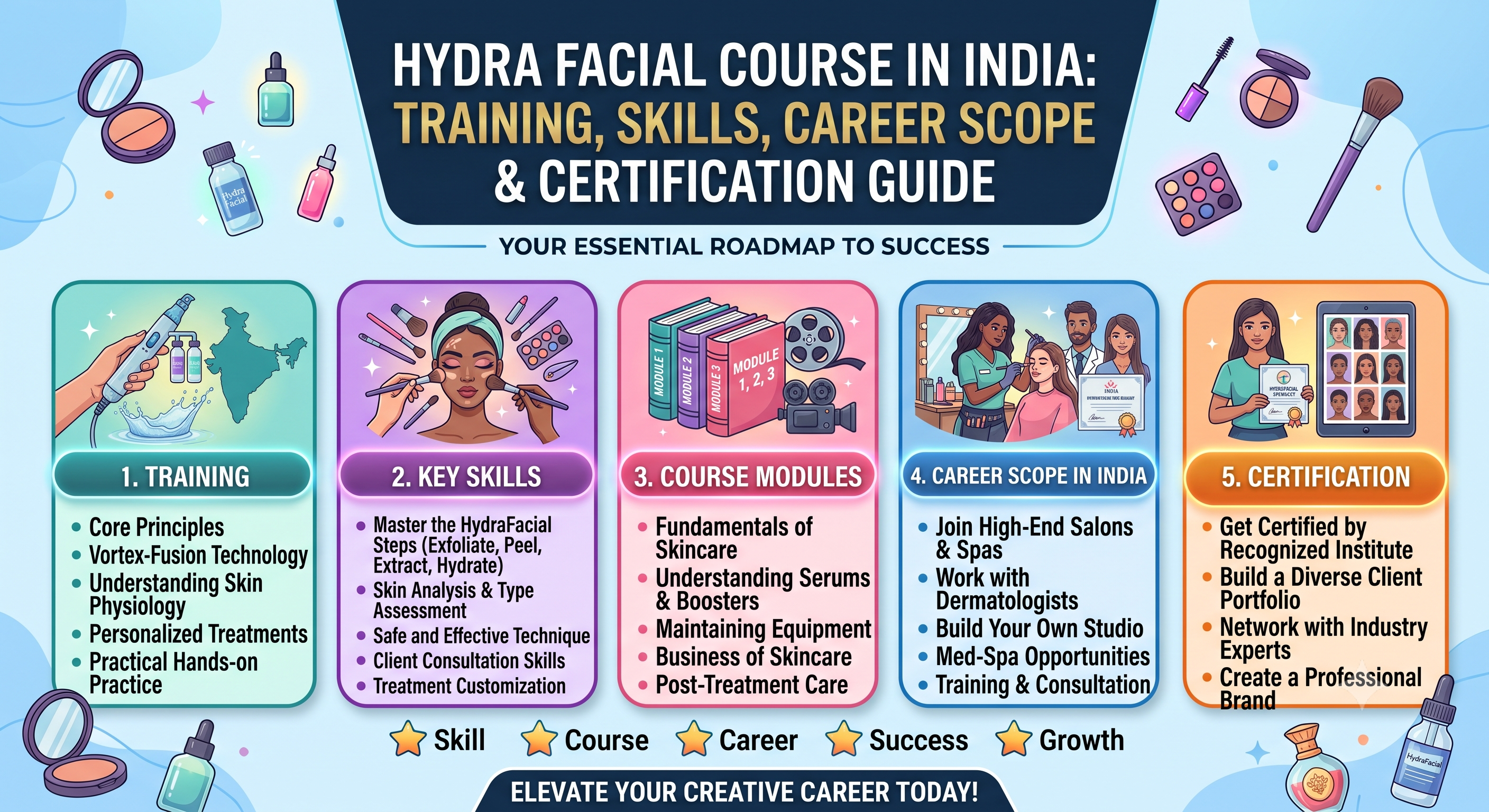
This complete guide covers HydraFacial training in India, eligibility, course curriculum, skills, practical training, certification, career opportunities, earning potential, and how to choose the right course.
What Is a HydraFacial Course?
A HydraFacial course is a specialized skincare training program designed to teach professionals how to perform or understand multi-step facial treatments using appropriate equipment and professional skincare products.
Depending on the academy and equipment used, training may introduce procedures involving:
- Skin cleansing
- Exfoliation
- Surface resurfacing
- Extraction
- Hydration
- Serum application
- Skin preparation
- Equipment handling
- Treatment customization
- Hygiene and sanitation
- Client consultation
- Aftercare
The term HydraFacial can refer specifically to a branded treatment, while other academies may teach similar hydrodermabrasion or hydradermabrasion-style procedures using different equipment. Students should check exactly which machine, products, and protocol are covered by the course.
Why Learn HydraFacial Techniques in India?
Professional skincare is becoming increasingly specialized. Clients often want treatments that provide a more comprehensive experience than a traditional basic facial.
For beauty professionals, advanced facial training can help us:
- Expand our service menu
- Improve skincare knowledge
- Offer customized facial experiences
- Work with modern beauty equipment
- Increase professional versatility
- Develop specialized skincare skills
- Build confidence in advanced facial procedures
Learning an advanced facial technique can also complement existing skills in beautician services, skincare, makeup, hair, and salon management.
Who Can Join a HydraFacial Course?
Eligibility depends on the training institute and the exact nature of the course.
Potential learners may include:
- Professional beauticians
- Beauty therapists
- Skincare professionals
- Salon professionals
- Makeup and beauty professionals
- Beauty students
- Spa professionals
- Salon owners
- Individuals with relevant beauty training
Beginners may find it more useful to first learn basic skincare, skin analysis, hygiene, and facial procedures before moving into advanced equipment-based treatments.
For procedures that may fall within medical aesthetics or involve regulated devices, learners should verify the relevant professional qualifications and local requirements before enrolling or offering services.
HydraFacial Course Eligibility in India
There is no single universal eligibility standard for every HydraFacial-related course in India.
Training academies may establish their own admission criteria. Some introductory programs may accept beginners, while advanced programs may be designed specifically for trained beauty or skincare professionals.
Before joining, we should check:
- Minimum educational qualification
- Previous beauty training requirements
- Practical experience requirements
- Equipment used during training
- Certification provided
- Scope of the training
- Whether the course is cosmetic or clinical in nature
This helps ensure that the course matches our existing qualifications and career goals.
What Do We Learn in a HydraFacial Course?
A comprehensive training program should cover both theory and practical application.
1. Basic Skin Knowledge
Before performing advanced facial services, professionals need a solid understanding of skin.
Training may cover:
- Basic skin anatomy
- Skin types
- Skin characteristics
- Skin barrier
- Hydration
- Sebum
- Common cosmetic skin concerns
- Basic skin analysis
Understanding skin helps professionals select appropriate products and procedures.
2. Skin Analysis
Skin analysis is an important part of treatment planning.
We learn how to observe:
- Dryness
- Excess oil
- Dehydration
- Texture
- Congestion
- Visible pores
- Uneven-looking skin tone
- Sensitivity
- Other cosmetic concerns
A professional should never assume that the same treatment intensity is suitable for every client.
3. Cleansing and Skin Preparation
Proper preparation helps create a clean and suitable surface for subsequent treatment steps.
Students may learn:
- Makeup removal
- Cleansing
- Product selection
- Skin preparation
- Appropriate application techniques
The procedure should always follow the manufacturer’s recommended protocol for the specific equipment and products being used.
4. Exfoliation
Exfoliation is commonly included in multi-step facial treatments.
Training should explain:
- Purpose of exfoliation
- Different exfoliation approaches
- Product selection
- Appropriate treatment intensity
- Skin sensitivity considerations
- When exfoliation should be avoided
Over-exfoliation can irritate the skin and compromise its protective barrier, so professionals should learn to work conservatively.
5. Extraction Techniques
One of the commonly discussed components of hydrodermabrasion or HydraFacial-style treatments is extraction.
Depending on the equipment and protocol, specialized suction may be used to help remove surface debris and congestion.
Students should learn:
- Correct equipment handling
- Appropriate suction settings
- Safe application
- Treatment-area selection
- Contraindications
- Hygiene
- Post-treatment care
Equipment should always be used according to its manufacturer’s instructions.
6. Hydration and Serum Application
Hydration is another key part of these treatments.
Professional training may introduce the use of cosmetic serums containing ingredients intended to support hydration or improve the appearance of the skin.
Common cosmetic ingredients may include:
- Hyaluronic acid
- Antioxidant ingredients
- Niacinamide
- Peptides
- Botanical ingredients
The exact products used depend on the treatment system and manufacturer’s protocol.
7. Equipment Handling
Advanced facial treatments require professionals to understand the equipment they are using.
Training should cover:
- Machine setup
- Handpiece handling
- Appropriate settings
- Attachments
- Product flow
- Suction control
- Cleaning
- Maintenance
- Troubleshooting
Improper equipment handling can result in poor treatment outcomes or skin irritation, which is why hands-on supervision is important.
8. Hygiene and Sanitation
Hygiene is one of the most important parts of professional facial training.
Professionals should learn how to:
- Clean treatment surfaces
- Sanitize reusable equipment appropriately
- Use disposable components when required
- Handle products hygienically
- Prevent cross-contamination
- Maintain clean towels
- Clean equipment after every treatment
- Follow manufacturer’s cleaning instructions
Advanced equipment does not replace basic hygiene standards.
Client Consultation Before a HydraFacial Treatment
Professional consultation should take place before treatment.
We should understand:
- Client expectations
- Current skincare routine
- Skin sensitivity
- Recent cosmetic procedures
- Current irritation
- Known allergies or sensitivities
- Products being used
- Previous facial treatments
- Desired outcome
The client’s treatment history is particularly important because some cosmetic or aesthetic procedures may require a waiting period before another treatment.
Understanding Contraindications
A responsible professional needs to know when a treatment should be postponed, modified, or referred to an appropriate healthcare professional.
Potential concerns may include:
- Active skin infections
- Open wounds
- Significant irritation
- Severe inflammation
- Certain active skin conditions
- Recent invasive cosmetic procedures
- Known sensitivity to treatment products
The exact contraindications depend on the equipment, products, and treatment protocol.
A trained beauty professional should never attempt to diagnose a medical skin condition. When there is uncertainty or a potentially medical concern, appropriate professional medical advice should be sought.
HydraFacial Training: Theory vs Practical Learning
A strong course should balance theoretical education with hands-on training.
Theory Training
Students should understand:
- Skin fundamentals
- Treatment principles
- Product knowledge
- Equipment functions
- Hygiene
- Consultation
- Contraindications
- Aftercare
Practical Training
Students should practise:
- Machine setup
- Handpiece handling
- Treatment sequence
- Product application
- Suction control
- Treatment timing
- Equipment cleaning
- Client communication
Hands-on practice is especially important because equipment-based facial treatments require coordination and controlled technique.
What Skills Do We Develop After HydraFacial Training?
After appropriate training and practice, learners can develop skills in:
Skin Analysis
Understanding basic skin characteristics and treatment requirements.
Equipment Handling
Learning how to operate the specific machine according to its intended protocol.
Treatment Customization
Adapting appropriate steps based on skin characteristics and client requirements within the professional scope of practice.
Product Knowledge
Understanding the purpose and correct application of professional skincare products.
Hygiene
Maintaining clean equipment, tools, and treatment areas.
Client Consultation
Understanding expectations and identifying situations where treatment should be modified or postponed.
HydraFacial Course Duration in India
Course duration varies considerably between training providers.
A short workshop may introduce basic machine operation, while a more comprehensive program can include:
- Skin theory
- Product education
- Equipment training
- Demonstrations
- Hands-on practice
- Consultation
- Hygiene
- Aftercare
Instead of selecting a course solely because it is short or inexpensive, we should evaluate the amount of practical training and quality of instruction.
HydraFacial Certification in India
Many beauty academies issue certificates after completion of their training programs.
A certificate may demonstrate that the learner completed a particular course, but we should understand exactly what the certificate represents.
Before enrolling, ask:
- Who issues the certificate?
- What curriculum does it cover?
- Is practical assessment included?
- What equipment is covered?
- Does it certify a branded treatment or a general technique?
- Is refresher training available?
- Does the certification have limitations?
Certification should be considered alongside practical competence, trainer quality, equipment knowledge, and professional experience.
Career Opportunities After HydraFacial Training
Advanced facial training can complement several beauty careers.
1. Professional Beautician
Beauticians can add advanced facial services to an existing skincare portfolio, where appropriate.
2. Skincare Specialist
Professionals focused on skincare can use advanced facial knowledge as part of a broader service offering.
3. Salon Professional
Established salons may offer equipment-based facial services as part of their premium skincare menu.
4. Spa Professional
Spas may provide advanced facial and relaxation treatments as part of their service portfolio.
5. Salon Entrepreneur
Experienced professionals can incorporate advanced skincare services into their own salon or beauty studio.
6. Beauty Trainer
Experienced professionals may eventually teach skincare and facial techniques to students, subject to appropriate qualifications and training.
How HydraFacial Training Can Improve a Beauty Business
Adding advanced skincare services can help salons diversify their service menu.
A salon can combine facial services with:
- Basic facials
- Cleanup
- De-tan services
- Skin preparation
- Hair services
- Makeup
- Bridal packages
- Nail services
However, the focus should remain on appropriate treatment selection and client satisfaction, rather than recommending advanced services to every customer.
How Much Can We Earn After HydraFacial Training?
Income depends on several factors, including:
- Location
- Experience
- Salon type
- Client base
- Service pricing
- Number of bookings
- Equipment investment
- Product costs
- Professional reputation
Professionals working in established salons may receive a salary or service-based incentives, while independent salon owners and freelancers may generate revenue directly from appointments.
The financial return also depends on the cost of equipment, consumables, maintenance, training, and marketing.
How to Choose the Best HydraFacial Course in India
Choosing the right academy is important.
Look for Practical Training
Ask whether students get supervised hands-on practice rather than only watching demonstrations.
Check the Equipment
Find out which machine and treatment system are used during training.
Review the Curriculum
The course should ideally include:
- Skin knowledge
- Treatment protocol
- Product knowledge
- Equipment operation
- Hygiene
- Consultation
- Contraindications
- Aftercare
Check Trainer Experience
Experienced trainers can provide better guidance on equipment handling, client communication, and troubleshooting.
Understand the Certification
Ask what certification is issued and what it actually covers.
Check Support After Training
Some academies may offer refresher training or guidance after course completion. This can be valuable when starting professional services.
Common Mistakes Beginners Should Avoid
Beginners should avoid treating equipment-based skincare as a simple machine operation.
Common mistakes include:
- Skipping client consultation
- Using incorrect machine settings
- Applying excessive suction
- Ignoring skin sensitivity
- Poor equipment hygiene
- Using incompatible products
- Skipping aftercare
- Performing treatments outside professional scope
- Making medical claims
- Treating every client identically
The most important principle is to follow the manufacturer’s instructions and professional training for the specific equipment and products being used.
Frequently Asked Questions
What is a HydraFacial course?
A HydraFacial course teaches learners about multi-step facial treatment techniques involving cleansing, exfoliation, extraction, hydration, equipment operation, product use, hygiene, consultation, and aftercare. The exact protocol varies by treatment system.
Who can learn HydraFacial in India?
Eligibility depends on the academy and treatment scope. Beauty professionals, skincare professionals, salon workers, and appropriately trained beginners may find relevant courses. Advanced or clinical procedures may require additional qualifications.
Is a HydraFacial certificate useful?
A certificate can document completion of a training program. However, practical skills, equipment-specific training, hygiene knowledge, and professional competence are equally important.
How long does a HydraFacial course take?
Duration varies by training provider. Short workshops may cover introductory machine operation, while comprehensive programs provide more extensive theory and hands-on practice.
Can a beautician perform HydraFacial?
This depends on the specific treatment, equipment, professional qualification, and applicable local requirements. Beauticians should only provide services that fall within their training and permitted professional scope.
Is HydraFacial a medical treatment?
The term can refer to a branded cosmetic treatment, while similar hydrodermabrasion-style procedures may use different devices and protocols. Some aesthetic procedures can fall within medical practice depending on the equipment and jurisdiction. Professionals should verify the applicable requirements before offering treatment.
What should we learn before taking a HydraFacial course?
A foundation in basic skincare, skin types, facial procedures, hygiene, product knowledge, and client consultation can make advanced facial training easier to understand and apply.
Conclusion
A HydraFacial course in India can be a valuable specialization for beauty professionals who want to expand their skincare knowledge and learn modern equipment-based facial techniques.
A quality training program should go beyond machine operation. It should teach skin analysis, treatment principles, product knowledge, equipment handling, hygiene, consultation, contraindications, aftercare, and practical application.
For aspiring beauticians and skincare professionals, advanced facial training can complement existing skills and create additional career opportunities in salons, spas, skincare studios, and beauty businesses.
The most important step is to choose training that provides genuine hands-on practice, experienced instruction, appropriate certification, and clear guidance about professional scope. With strong foundational skincare knowledge and continuous professional development, advanced facial skills can become a valuable addition to a modern beauty career.