Beauty Skills to Learn in 2026: Complete Guide for Beginners & Aspiring Beauticians
Beauty Skills to Learn in 2026: Complete Guide for Beginners & Aspiring Beauticians
The beauty and wellness industry is evolving rapidly in 2026. Clients today expect more than basic salon services—they look for professional expertise, modern techniques, personalized consultations, hygiene, creativity, and visible results. For anyone planning a career in the beauty industry, learning the right beauty skills can create opportunities in salons, beauty academies, spas, freelance services, bridal makeup, and even entrepreneurship.
Whether we are complete beginners, recent graduates, homemakers looking for a professional skill, or aspiring salon owners, building a strong foundation in beauty skills is essential. The right training can help us develop confidence, improve our technical ability, and provide professional-quality services.
What Beauty Skills Should We Learn in 2026?
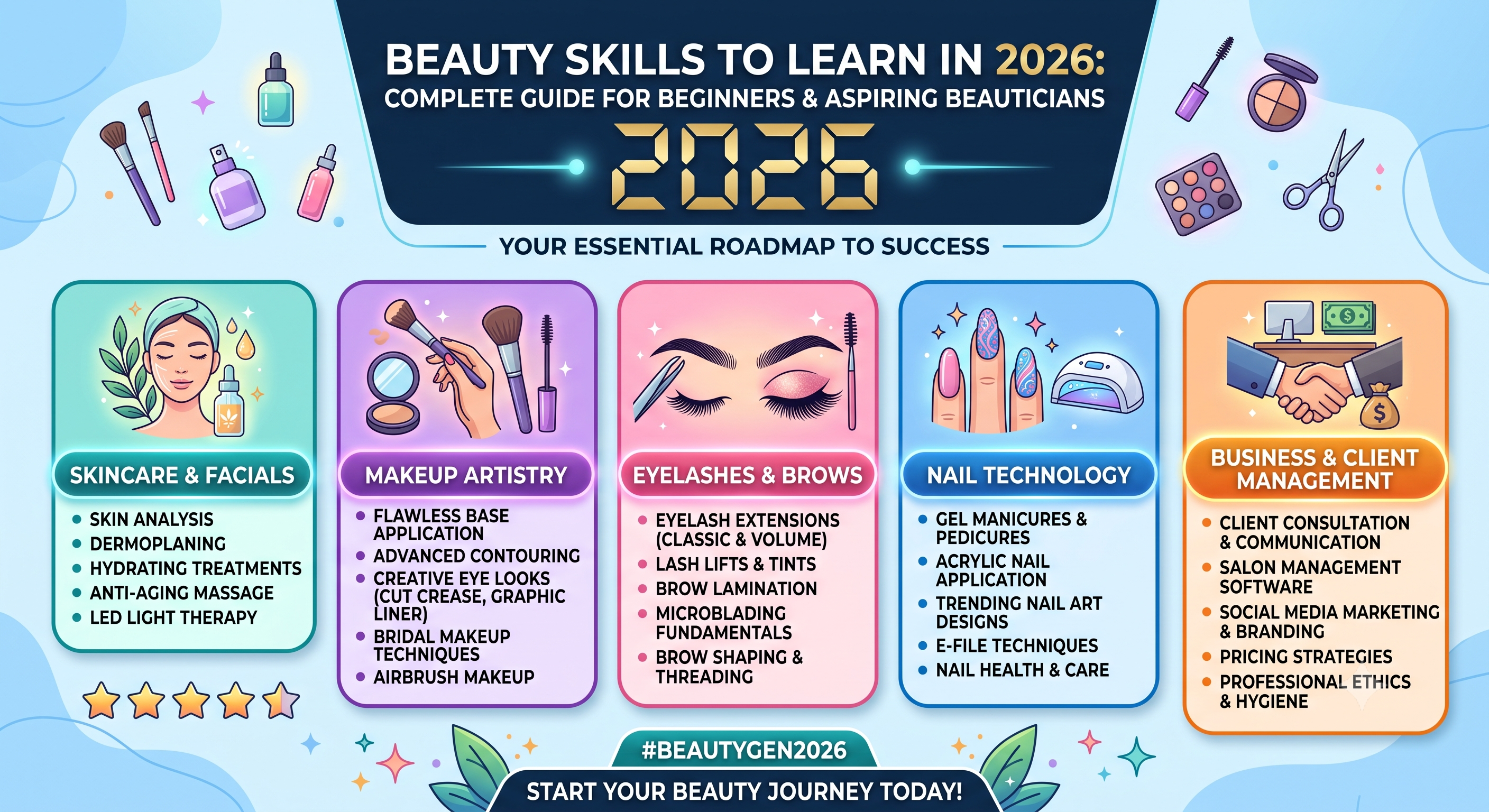
A successful beautician needs a combination of technical skills, creative skills, customer-service abilities, product knowledge, and business awareness. Modern beauty professionals are expected to understand everything from hair styling and skincare to makeup, nails, hygiene, consultation, and salon management.
Here are some of the most valuable beauty skills to learn in 2026:
- Professional Hair Cutting
- Hair Styling and Blow-Drying
- Hair Colouring
- Hair Smoothening and Advanced Hair Treatments
- Professional Makeup
- Bridal Makeup
- Skincare and Facial Treatments
- Manicure and Pedicure
- Nail Art and Nail Extensions
- Eyebrow Shaping and Waxing
- Hair Spa and Scalp Care
- Salon Hygiene and Safety
- Client Consultation
- Product Knowledge
- Salon Management and Business Skills
Let’s explore these skills in detail.
1. Professional Hair Cutting Skills
Hair cutting remains one of the most important skills for a professional beautician. A good haircut requires more than simply using scissors. We need to understand face shape, hair texture, density, length, growth patterns, and client preferences.
Beginners should learn fundamental techniques such as:
- Blunt cutting
- Layer cutting
- Graduation
- Step cutting
- U-cut and V-cut
- Bob cuts
- Pixie cuts
- Long layers
- Fringe and bangs
- Men’s and women’s basic haircutting
Advanced training should also cover sectioning, elevation, texturizing, finishing, and adapting haircuts according to different face shapes.
2. Hair Styling and Blow-Drying
Professional hair styling is another highly useful beauty skill. Clients frequently request hairstyles for parties, weddings, events, photoshoots, and everyday occasions.
We should learn techniques such as professional blow-drying, straightening, curling, braiding, updos, ponytails, and heat styling. Understanding how different hair textures react to heat is equally important.
A professional stylist should also know how to use styling products correctly and protect hair from excessive heat.
3. Hair Colouring and Global Hair Colour
Hair colouring has become one of the most popular salon services. Learning professional hair colour techniques can significantly expand our service portfolio.
Important areas include:
- Global hair colour
- Root touch-up
- Grey coverage
- Highlights
- Lowlights
- Balayage
- Ombre
- Colour correction
- Bleaching
- Toners
- Pre-lightening
- Colour formulation
We should also understand colour theory and the underlying pigment of hair. This knowledge helps us choose appropriate shades and avoid unwanted colour results.
4. Advanced Hair Treatments
Modern clients increasingly seek professional solutions for frizz, dryness, roughness, and manageability. Therefore, learning advanced hair treatments can be highly valuable.
Training may include:
- Keratin treatments
- Hair smoothening
- Nanoplastia
- Hair Botox
- Deep conditioning
- Hair spa
- Scalp treatments
- Damage-repair treatments
A professional should always assess the client’s hair condition before recommending a treatment. Understanding previous chemical services, hair porosity, elasticity, and damage level helps us select the appropriate service.
5. Professional Makeup Skills
Makeup is one of the most creative and commercially valuable beauty skills. Beginners should first master the fundamentals before moving toward advanced techniques.
Essential makeup skills include:
- Skin preparation
- Foundation matching
- Concealer application
- Contouring
- Highlighting
- Blush application
- Eye makeup
- Eyeliner
- Eyeshadow blending
- Eyebrow shaping
- False-lash application
- Lip makeup
- Makeup setting
We should also learn how to create different looks for daytime, parties, photoshoots, engagements, weddings, and professional events.
6. Bridal Makeup Skills
Bridal makeup requires a higher level of precision because the final look needs to remain beautiful under different lighting conditions and throughout long events.
A bridal makeup course should cover HD makeup, long-lasting makeup, eye makeup, complexion correction, hairstyling, draping, and customized bridal looks.
We should also learn how to understand a bride’s outfit, jewellery, hairstyle, skin type, and personal preferences before designing the final look.
7. Skincare and Facial Skills
Professional skincare knowledge is essential for beauticians. We need to understand different skin types and common concerns before selecting products or treatments.
Important skills include:
- Skin analysis
- Cleansing
- Exfoliation
- Steam
- Extraction
- Face massage
- Face masks
- Cleanup
- Facial techniques
- De-tan treatments
- Basic skin consultation
Different clients may have dry, oily, combination, sensitive, or normal skin. Professional training helps us select suitable techniques and products instead of following the same procedure for everyone.
8. Manicure, Pedicure and Nail Care
Nail services have become an important part of the beauty industry. Beginners can start with basic manicure and pedicure before progressing toward advanced nail services.
We can learn:
- Nail shaping
- Cuticle care
- Hand and foot massage
- Basic manicure
- Basic pedicure
- Nail polish application
- French manicure
- Nail art
- Gel nails
- Nail extensions
Attention to sanitation and tool hygiene is particularly important when providing nail services.
9. Nail Art and Creative Nail Design
Nail art combines technical ability with creativity. Modern clients often request customized designs for weddings, festivals, parties, and special occasions.
Useful techniques include minimalist designs, French styles, chrome effects, floral patterns, glitter application, geometric designs, and decorative elements.
Practising regularly is one of the best ways to improve nail-art precision.
10. Eyebrow Shaping and Waxing
Basic grooming services are among the most frequently requested salon services. Beauticians should learn safe and precise eyebrow shaping along with waxing techniques.
Training should include:
- Eyebrow threading
- Eyebrow shaping
- Upper-lip waxing
- Full-face waxing
- Hand and leg waxing
- Underarm waxing
- Basic body-waxing techniques
We should understand skin sensitivity, contraindications, product application, and aftercare to provide safer services.
11. Hair Spa and Scalp Care
Healthy-looking hair begins with proper scalp and hair care. Hair spa services can be customized according to dryness, damage, oiliness, or other hair concerns.
A professional should understand cleansing, conditioning, massage techniques, masks, steam, and appropriate product selection.
Scalp-care knowledge can also improve consultation skills because clients frequently ask beauticians about maintaining healthier-looking hair between salon visits.
12. Salon Hygiene and Professional Safety
Technical beauty skills are incomplete without hygiene knowledge. Professional salons must maintain clean tools, workstations, towels, equipment, and treatment areas.
We should develop habits such as:
- Cleaning tools after use
- Sanitizing reusable equipment
- Maintaining clean workstations
- Using disposable items where appropriate
- Washing or sanitizing hands
- Proper towel management
- Safe product storage
- Following manufacturer instructions
- Maintaining clean treatment areas
Hygiene builds client confidence and supports professional salon standards.
13. Client Consultation Skills
Excellent consultation skills can distinguish a beginner from a professional beautician. Before performing a service, we should understand exactly what the client wants.
A good consultation considers:
- Client expectations
- Hair or skin condition
- Previous treatments
- Lifestyle
- Maintenance requirements
- Budget
- Desired result
- Possible limitations
Clear communication also helps prevent misunderstandings and creates a better client experience.
14. Beauty Product Knowledge
Professional beauticians should understand the products they use. Instead of memorizing brand names alone, we should learn about ingredients, product purposes, application methods, compatibility, and precautions.
Product knowledge is particularly important for hair colour, chemical treatments, skincare, makeup, and professional nail services.
15. Salon Management Skills
For those who want to become salon owners or managers, technical beauty training should be combined with business skills.
Important areas include:
- Appointment management
- Staff management
- Inventory management
- Customer retention
- Service pricing
- Basic accounting
- Marketing
- Social media promotion
- Client feedback
- Upselling and cross-selling
- Salon operations
A talented beautician can provide excellent services, but strong management skills can help turn those services into a sustainable business.
Why Should We Learn Multiple Beauty Skills?
Learning multiple related skills allows us to offer a wider range of services. For example, a beautician who understands hair, makeup, skincare, nails, and basic salon management can work in a broader range of professional environments.
Multiple skills can also help us:
- Increase earning opportunities
- Serve different client requirements
- Work independently
- Build a freelance career
- Start a home salon
- Open a professional salon
- Work in established salons
- Provide bridal services
- Become a beauty educator
How to Start Learning Beauty Skills as a Beginner
Beginners should avoid trying to master everything simultaneously. A structured learning path is more effective.
We can begin with basic hygiene, skincare, hair fundamentals, and basic makeup. Once the foundation is strong, we can progress toward advanced hair colour, bridal makeup, chemical treatments, nail services, and salon management.
Practical training is particularly important. Watching tutorials can introduce techniques, but repeated hands-on practice helps develop the precision, speed, confidence, and consistency required in professional salon work.
Beauty Skills Career Opportunities in 2026
After developing professional beauty skills, we can explore several career paths:
- Beautician
- Hair stylist
- Hair colourist
- Makeup artist
- Bridal makeup artist
- Nail artist
- Skincare professional
- Salon manager
- Freelance beauty professional
- Beauty trainer
- Salon entrepreneur
- Beauty content creator
The beauty industry also offers opportunities to combine several skills. For example, a professional may specialize in bridal services while offering makeup, hairstyling, skincare preparation, and draping.
Best Beauty Skills for Beginners to Learn First
If we are starting from zero, the following progression provides a practical foundation:
Step 1: Learn salon hygiene and safety.
Step 2: Understand basic skincare and facial procedures.
Step 3: Learn eyebrow shaping and waxing fundamentals.
Step 4: Develop basic hair cutting and styling skills.
Step 5: Learn professional makeup fundamentals.
Step 6: Practise manicure, pedicure, and nail basics.
Step 7: Progress to hair colouring and advanced treatments.
Step 8: Learn bridal makeup and advanced hairstyling.
Step 9: Develop client consultation skills.
Step 10: Learn salon management and business fundamentals.
Frequently Asked Questions About Beauty Skills
What are the most important beauty skills to learn in 2026?
The most valuable skills include hair cutting, hair styling, hair colouring, makeup, bridal makeup, skincare, facial treatments, nail services, waxing, client consultation, hygiene, and salon management.
Can beginners learn professional beauty skills?
Yes. Beginners can develop professional skills through structured education and consistent practical training. Starting with basic techniques and gradually progressing toward advanced services makes the learning process more manageable.
Which beauty skill has good career potential?
Hair styling, professional makeup, bridal makeup, hair colouring, advanced hair treatments, skincare, and nail services can all provide career opportunities. The best choice depends on individual interests, training, local demand, and professional specialization.
How long does it take to learn beautician skills?
The duration depends on the course structure and the skills being learned. Basic courses can establish foundational techniques, while advanced professional programs require additional practical training and continued practice.
Is practical training important for becoming a beautician?
Yes. Beauty services are hands-on professions. Practical training helps us develop technique, precision, speed, confidence, hygiene habits, and client-handling skills.
Final Thoughts
The beauty industry in 2026 offers exciting opportunities for people who are willing to develop professional skills and continue learning. From hair cutting and colouring to makeup, skincare, nail art, advanced treatments, and salon management, there are numerous areas in which aspiring beauticians can specialize.
The strongest beauty professionals are not simply those who know the most techniques. They are professionals who combine technical expertise, creativity, hygiene, consultation, product knowledge, communication, and consistent practice.
For beginners and aspiring beauticians, the best approach is to build a strong foundation first and then develop advanced skills through structured training and regular hands-on practice. With the right combination of education, practice, professionalism, and creativity, beauty skills can become the foundation for a rewarding career in the modern beauty and wellness industry.