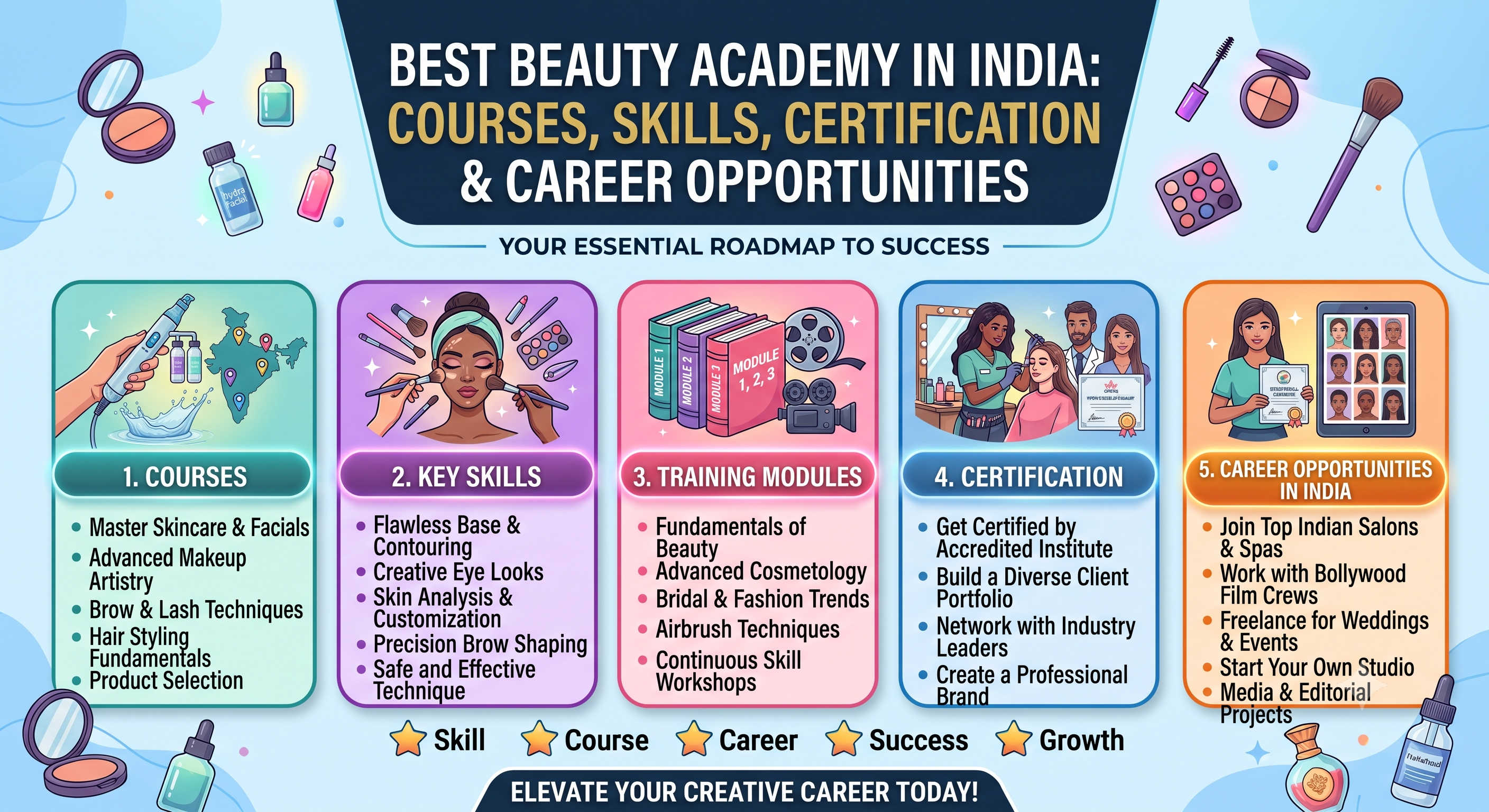
Best Beauty Academy in India: Courses, Skills, Certification & Career Opportunities
Best Beauty Academy in India: Courses, Skills, Certification & Career Opportunities
Choosing the best beauty academy in India can be an important decision for anyone planning a professional career in the beauty and wellness industry. With growing demand for hairstylists, beauticians, makeup artists, skincare professionals, nail technicians, and salon managers, professional beauty education can provide the practical foundation needed to enter this competitive industry.
However, choosing a beauty academy should involve more than comparing course fees or certificates. A quality academy should provide practical training, experienced trainers, modern techniques, professional products, hygiene education, industry-relevant skills, and opportunities for hands-on practice.
Whether we are students after Class 10 or 12, graduates, working professionals, homemakers, or aspiring entrepreneurs, the right beauty academy can help us turn an interest in beauty into a structured career.
This guide explains what to look for in the best beauty academy in India, popular courses, essential skills, certification, practical training, career opportunities, and how to choose the right program.
What Is a Beauty Academy?
A beauty academy is a professional training institute that teaches students practical skills related to the beauty, salon, makeup, hair, skincare, and wellness industries.
Depending on the academy, courses may cover:
- Beautician training
- Hair cutting
- Hair styling
- Hair colouring
- Makeup artistry
- Bridal makeup
- Skincare
- Facial treatments
- Nail art
- Nail extensions
- Manicure and pedicure
- Hair spa
- Advanced hair treatments
- Salon management
- Self grooming
Some academies offer individual specialization courses, while others provide comprehensive hair, skin, makeup, and beauty programs.
Why Choose Professional Beauty Training in India?
Beauty is a practical profession. While online tutorials can introduce techniques, professional training provides structured learning and supervised practice.
A good beauty academy can help students develop:
- Technical skills
- Practical confidence
- Product knowledge
- Client consultation skills
- Hygiene practices
- Professional communication
- Time management
- Service customization
- Industry awareness
Professional training can also reduce the learning curve for beginners by providing a structured curriculum instead of relying on random online tutorials.
Popular Beauty Courses in India
The best course depends on our career objective. Some students want to become complete beauticians, while others prefer to specialize in makeup, hair, skincare, or nails.
1. Professional Beautician Course
A professional beautician course provides foundational training across multiple beauty services.
The curriculum may include:
- Facial and cleanup
- Skincare
- Threading
- Waxing
- Manicure
- Pedicure
- Basic makeup
- Hair care
- Hair styling
- Salon hygiene
- Client consultation
This can be a suitable starting point for beginners who want broad salon skills.
2. Makeup Artist Course
Students interested in makeup can specialize in professional makeup artistry.
Training may include:
- Skin preparation
- Foundation matching
- Concealing
- Colour correction
- Contouring
- Highlighting
- Eye makeup
- Eyeliner
- Lashes
- Lip makeup
- Party makeup
- Professional makeup
Advanced programs may also include HD makeup and airbrush makeup.
3. Bridal Makeup Course
Bridal makeup is a popular specialization in India’s beauty industry.
A bridal makeup course can cover:
- Bridal skin preparation
- Traditional bridal makeup
- Contemporary bridal makeup
- HD bridal makeup
- Long-lasting makeup
- Eye makeup
- Hairstyling
- Hair accessories
- Dupatta setting
- Engagement makeup
- Reception looks
Students should also learn how makeup interacts with wedding photography, video, lighting, jewellery, and outfits.
4. Hair Styling Course
Hair is one of the largest professional categories within the beauty industry.
Students can learn:
- Blow-drying
- Hair curling
- Straightening
- Braiding
- Ponytails
- Buns
- Updos
- Party hairstyles
- Bridal hairstyles
- Hair accessories
Advanced training may progress toward professional hairdressing and salon techniques.
5. Hair Cutting Course
Professional haircutting requires technical understanding and consistent practice.
Training may include:
- Basic cutting
- Blunt cuts
- Layering
- Graduation
- Step cuts
- Bob cuts
- Fringe
- Men’s cuts
- Women’s cuts
- Sectioning
- Finishing
Students should learn how to adapt haircuts according to hair texture, density, length, and face shape.
6. Hair Colouring Course
Hair colouring has become a major salon specialization.
Training can cover:
- Global colour
- Root touch-ups
- Grey coverage
- Highlights
- Lowlights
- Balayage
- Ombre
- Toners
- Bleaching
- Colour correction
- Colour theory
Understanding underlying pigment and colour formulation is particularly important for professional results.
7. Skincare and Facial Course
Skincare professionals need a strong understanding of skin types and cosmetic treatments.
Training may include:
- Skin analysis
- Cleansing
- Exfoliation
- Steam
- Extraction
- Face massage
- Facial procedures
- Masks
- Cleanup
- Basic skin consultation
Advanced academies may also offer specialized facial and equipment-based training.
8. Nail Art and Nail Extension Course
Nail services have become an increasingly popular specialization.
Students can learn:
- Manicure
- Pedicure
- Nail shaping
- Nail polish
- French nails
- Nail art
- Gel techniques
- Nail extensions
- Nail maintenance
Hygiene and tool sanitation should be an important part of professional nail training.
9. Advanced Hair Treatment Courses
Professionals can specialize in advanced hair services such as:
- Hair spa
- Keratin treatments
- Hair smoothening
- Nanoplastia
- Hair Botox
- Deep conditioning
- Professional scalp-care services
These services require appropriate product knowledge, hair assessment, safety practices, and manufacturer-specific protocols.
10. Salon Management Course
Beauty professionals interested in entrepreneurship should also develop business skills.
Salon management training may include:
- Staff management
- Appointment scheduling
- Inventory
- Pricing
- Customer service
- Marketing
- Basic accounting
- Sales
- Client retention
- Salon operations
Technical beauty skills and business knowledge together can provide a stronger foundation for salon entrepreneurship.
What Skills Should We Learn at the Best Beauty Academy?
A high-quality academy should help students develop both technical and professional abilities.
Technical Beauty Skills
Students should have opportunities to learn:
- Hair cutting
- Hair styling
- Hair colouring
- Makeup
- Bridal makeup
- Skincare
- Facial techniques
- Nail care
- Waxing
- Threading
- Hair treatments
Client Consultation Skills
Professional beauty services should be customized according to client requirements.
Students should learn how to:
- Ask appropriate questions
- Understand expectations
- Assess basic hair or skin characteristics
- Explain services
- Discuss maintenance
- Provide appropriate aftercare
Communication Skills
Beauty professionals interact directly with clients, so communication is essential.
Students should learn to communicate professionally, listen carefully, and maintain a respectful and comfortable salon environment.
Time Management
Salon professionals often handle multiple appointments. Learning how to organize services efficiently can improve both productivity and customer experience.
Hygiene and Safety
Professional hygiene should be integrated into every beauty course.
Students should learn:
- Tool sanitation
- Hand hygiene
- Workstation cleaning
- Product handling
- Towel hygiene
- Disposable applicator use
- Cross-contamination prevention
- Equipment cleaning
What Makes an Academy the Best Beauty Academy in India?
There is no single academy that is automatically the best for every student. The right choice depends on our career goal, preferred specialization, location, budget, training requirements, and desired course duration.
However, several qualities can help us identify a strong beauty academy.
1. Experienced Trainers
Trainers should have relevant industry experience and be able to demonstrate techniques clearly.
2. Practical Training
A beauty academy should provide significant hands-on practice rather than relying entirely on demonstrations.
3. Comprehensive Curriculum
The curriculum should cover the practical skills relevant to the course instead of focusing only on theoretical information.
4. Modern Techniques
Beauty trends and professional techniques change regularly. Students should be introduced to relevant contemporary methods.
5. Professional Products and Equipment
Training should use suitable professional tools and products and explain their correct application.
6. Small or Manageable Practical Groups
Where possible, smaller practical groups can allow trainers to provide more individual guidance.
7. Certification
Students should understand exactly what certificate they will receive and what training it represents.
8. Career Guidance
Support with portfolio development, interview preparation, salon exposure, or entrepreneurship can be valuable after training.
Beauty Academy Certification: What Should We Know?
Certification can demonstrate that a student completed a particular training program.
However, a certificate should not be considered a substitute for practical competence.
Before joining an academy, ask:
- Who issues the certificate?
- What course does it cover?
- Is there a practical assessment?
- How many practical sessions are included?
- Is the certificate course-specific?
- Does the academy offer advanced certifications?
- Is career guidance included?
The value of professional training comes from the combination of knowledge, practical skill, experience, and certification.
How Long Does a Beauty Course Take?
Beauty course duration varies widely.
Short-term workshops may focus on one specific skill, while comprehensive professional programs may run for several months.
For example, students may choose:
- Short workshops
- One-month specialization programs
- Multi-month professional courses
- Advanced specialization programs
- Comprehensive beauty programs
Instead of selecting a course only because it is short, we should compare curriculum, practical hours, trainer experience, equipment, and hands-on opportunities.
Career Opportunities After Beauty Training
Professional beauty education can open several career paths.
1. Beautician
A trained beautician can provide skincare, grooming, facial, waxing, threading, manicure, pedicure, and other appropriate salon services.
2. Hair Stylist
Hair professionals can specialize in cutting, styling, colouring, treatments, and occasion hairstyles.
3. Makeup Artist
Makeup artists can work in salons, bridal services, events, studios, fashion, photography, and freelance environments.
4. Bridal Makeup Artist
Bridal specialists can develop services around weddings, engagements, receptions, and related events.
5. Nail Artist
Nail professionals can work in salons, nail studios, spas, or independently.
6. Skincare Professional
Those specializing in skincare can work in salons, spas, beauty studios, or other appropriate professional environments.
7. Beauty Trainer
Experienced professionals can become trainers and teach aspiring beauty students.
8. Freelancer
Freelancing provides flexibility and allows professionals to work independently.
9. Salon Owner
With sufficient technical experience and business knowledge, professionals can establish their own salon.
Career Opportunities After a Beauty Course in India
The Indian beauty industry offers opportunities across multiple settings.
Professionals can work in:
- Beauty salons
- Hair salons
- Makeup studios
- Spas
- Bridal studios
- Fashion environments
- Photography
- Events
- Beauty academies
- Freelance businesses
- Home-based beauty businesses
Experienced professionals can also develop their own brand and build a client network through digital marketing and referrals.
How Much Can a Beauty Professional Earn in India?
Earnings vary depending on:
- Experience
- Location
- Specialization
- Salon type
- Client base
- Service pricing
- Portfolio quality
- Reputation
- Employment structure
Beginners may start with entry-level positions and increase their earning potential as their skills and experience grow.
Specialists in bridal makeup, hair colouring, advanced hair treatments, nail services, and premium beauty services may have different earning opportunities from general salon professionals.
Freelancers and business owners have additional factors such as marketing, equipment costs, product expenses, rent, staff, and client acquisition.
How to Choose the Best Beauty Academy for Your Career Goal
Instead of searching only for an academy with the word “best” in its advertising, we should identify what we actually want to learn.
If We Want to Become a Beautician
Look for a comprehensive course covering hair, skin, makeup, grooming, and salon hygiene.
If We Want to Become a Makeup Artist
Prioritize professional makeup, bridal makeup, HD techniques, hairstyling, and practical portfolio development.
If We Want to Become a Hair Professional
Look for strong training in haircutting, styling, colouring, treatments, and hair science.
If We Want to Become a Skincare Professional
Focus on skin analysis, facial procedures, product knowledge, hygiene, and advanced skincare training within the appropriate professional scope.
If We Want to Open a Salon
Choose a combination of technical beauty training and salon management or entrepreneurship education.
How to Prepare Before Joining a Beauty Academy
Students can make their training more productive by preparing beforehand.
We can:
- Learn basic beauty terminology
- Observe professional salon services
- Practise basic grooming
- Develop an interest in skincare and hair care
- Research different specializations
- Compare academy curricula
- Visit training facilities
- Ask about practical classes
- Understand course fees and inclusions
Most importantly, we should enter training with a willingness to practise repeatedly and accept constructive feedback.
Common Mistakes When Choosing a Beauty Academy
Students sometimes choose an academy based only on advertising.
Common mistakes include:
- Selecting only by low fees
- Choosing only by certificate claims
- Ignoring practical training
- Not checking trainer experience
- Failing to review the curriculum
- Not visiting the academy
- Ignoring student work
- Choosing a course that does not match career goals
- Expecting instant professional expertise after a short workshop
A better approach is to compare the complete learning experience.
Frequently Asked Questions
Which is the best beauty academy in India?
There is no single academy that is best for every learner. The right academy depends on the student’s career goal, location, specialization, budget, curriculum, practical training, trainer experience, and certification.
What is the best beauty course after 12th?
Students can choose professional beautician, makeup, hair, skincare, nail, or specialized courses after 12th. A comprehensive course can be useful for beginners who want broader salon skills.
Is a beauty academy certificate enough to get a job?
A certificate can demonstrate completion of training, but employers and clients also value practical ability, experience, communication, hygiene, and portfolio quality.
Can I become a makeup artist after joining a beauty academy?
Yes. Many beauty academies offer professional makeup and bridal makeup programs. Students can specialize further in HD, airbrush, fashion, or other makeup techniques.
Can beauty training help us start a salon?
Yes. Technical training can provide a foundation for salon services. However, aspiring salon owners should also develop business knowledge covering budgeting, staffing, marketing, inventory, customer retention, and operations.
Is practical training important in beauty courses?
Yes. Beauty is a hands-on profession. Practical training helps students develop precision, speed, confidence, client-handling ability, and consistent technique.
Conclusion
Choosing the best beauty academy in India is ultimately about finding the right training environment for our individual career goals. A strong academy should provide more than a certificate—it should help us develop practical skills, technical knowledge, professional confidence, hygiene awareness, client communication, and industry-ready techniques.
Whether our goal is to become a beautician, makeup artist, hairstylist, skincare professional, nail artist, freelancer, beauty trainer, or salon entrepreneur, professional training can provide a structured starting point.
Before enrolling, we should compare the curriculum, practical hours, trainers, equipment, certification, student work, career support, and specialization options. With the right education, consistent practice, and continuous learning, beauty training can become the foundation for a rewarding and sustainable career in India’s growing beauty and wellness industry.